





TOPPAN and K4SECURITY Validate Corporate Identity Integration for Digital Product Passports
Proof of concept links verifiable corporate credentials with DPP platform, addressing data authenticity and supply-chain verification for European market access
Tokyo – 24 November 2026 – TOPPAN Inc. and South Korean digital product passport (DPP) solutions provider K4SECURITY have completed a proof of concept (PoC) demonstrating the integration of verifiable corporate identity credentials into a Digital Product Passport issuance platform.
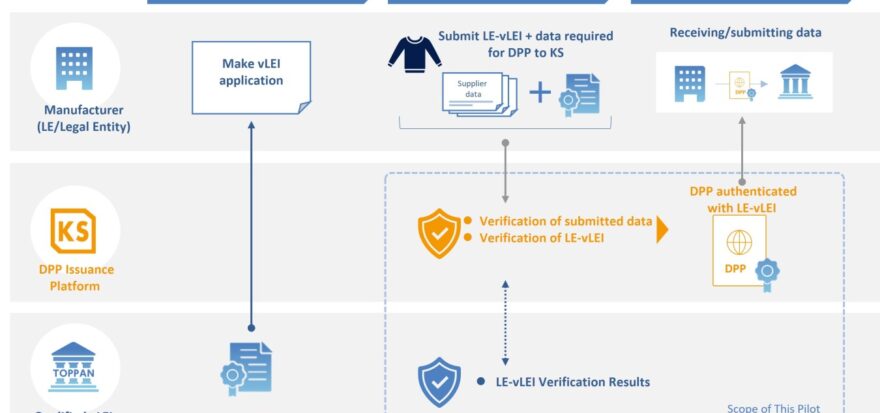
The technical verification, conducted between 29 June and 6 November 2026, linked TOPPAN’s verifiable Legal Entity Identifier (vLEI) credentials with K4SECURITY’s KSPTS (K4-Security Product Trust Service) DPP platform. The objective was to strengthen corporate identity verification and data authenticity for companies preparing to meet European DPP requirements.
During the PoC, the companies connected TOPPAN’s vLEI integration API to KSPTS. The system authenticated a company using its Legal Entity vLEI (LE-vLEI) before issuing a DPP, with the corresponding identification data subsequently stored within the passport.
According to the companies, the verification demonstrated that corporate identities could be established through credentials designed to prevent forgery or tampering, rather than relying solely on conventional text-based company codes.
The PoC also examined the potential extension of the system to downstream supply-chain participants, including importers, logistics providers, recyclers and disposal operators. Role-based credentials, known as ECR-vLEI, could be used to establish the authority of these participants and link their credentials to DPP data.
The companies confirmed that vLEI identifiers could be integrated into KSPTS without significant changes to its basic system architecture. They plan to conduct further pilot tests with manufacturing companies and collaborate with standardisation bodies and international organisations, including the Global Legal Entity Identifier Foundation (GLEIF), to develop a model for wider DPP applications.
Implications for packaging and manufacturing
The development highlights an important aspect of DPP implementation beyond the collection of product and sustainability information: establishing the authenticity of the organisations contributing data across a supply chain.
For packaging manufacturers and converters supplying products or components to international markets, the ability to verify corporate identities and manage data access across multiple supply-chain participants could become an important part of digital traceability infrastructure.
Under the EU’s Ecodesign for Sustainable Products Regulation (ESPR), DPP requirements are being introduced progressively for specified product groups through product-specific rules. Separate legislation, including the Packaging and Packaging Waste Regulation, also forms part of the wider European regulatory framework.
The TOPPAN–K4SECURITY PoC is an early technical demonstration of how corporate identity credentials could support more reliable DPP operations. Further manufacturing pilots and standardisation work will be needed before the approach can be assessed for wider commercial deployment.
Source: TOPPAN Inc. and K4SECURITY

