
Featured Posts
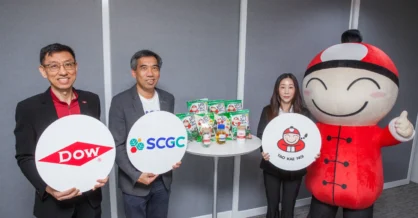
Bangkok – 25 February 2026: Marking the first-ever collaboration of three industry leaders, Taokaenoi Food & Marketing Public Company Limited, or TKN, a manufacturer of seaweed snacks distributed domestically and internationally, SCG Chemicals, or SCGC, a leading integrated polymer and solutions provider for sustainability, and Dow Thailand Group, or Dow, a global leader in materials science, have jointly announced the signing of a landmark Memorandum of Understanding (MoU) to revolutionize the snack industry through the “Food-Grade Circular Packaging by Advanced Recycling Technology” project. This initiative aims to sustainably address plastic waste challenges under the concept of closed-loop recycling. This collaboration entails utilizing multi-layer packaging waste from the production processes of Taokaenoi, which was previously difficult to recycle. This waste will be processed using the advanced recycling technology of SCGC and converted back into circular feedstock. Following this, Dow will utilize the feedstock to produce new, clean, and food-grade plastic resins. These resins will then be safely used to manufacture food packaging for the Taokaenoi brand once again. It is anticipated that the packaging will be ready for commercial distribution by the end of 2026. Ms. Orrapat Peeradechapan, Chief Executive Officer of Taokaenoi Food & Marketing Public Company Limited, said, “Taokaenoi is committed to creating happiness for consumers through high-quality snacks, alongside prioritizing ESG (Environmental, Social, and Governance) principles by emphasizing sustainable economic, social, and environmental development. This collaboration represents a significant milestone that transforms the ‘challenge’ of hard-to-recycle packaging into an ‘opportunity’ to establish a practical circular economy. It is not merely about waste disposal, but rather about creating new value from used plastic. We do not only deliver great-tasting products, but we also aim to deliver a better world to consumers through eco-friendly packaging innovations that are clean, safe, and tangibly reduce environmental impacts. This will drive our business to grow alongside genuine sustainability.” Dr. Suracha Udomsak, Chief Operations and Innovation Officer of SCGC, said, “This collaboration reflects the capability of SCGC in utilizing advanced recycling technology to manage plastic packaging composed of multiple materials, which is difficult to recycle, and converting it back into circular feedstock. This feedstock can be used to produce new plastic resins (Certified Circular Polyolefin Resin), which possess properties and quality entirely equivalent to standard virgin plastic resins in all respects and are safe for direct food contact. As a result, the materials can be reused to manufacture food packaging for Taokaenoi. In addition, our process has achieved the globally recognized sustainability certification, ISCC PLUS (International Sustainability and Carbon Certification), throughout the entire supply chain, making SCGC the first company in ASEAN to achieve such certification. This partnership is considered a crucial step in driving SCGC’s goal of reintegrating used plastic into the circular economy system at a volume of 500,000 tons per year by 2030, through collaborations with business partners across the entire value chain.” Meanwhile, Mr. Vichan Tangkengsirisin, President of Dow Thailand, added, “As a materials science leader, Dow is proud to support this collaboration in Thailand by applying our technology to produce circular plastic resins from used flexible packaging feedstock with performance equivalent to fossil-based plastics. Dow Thailand Group’s polyethylene facility in Rayong is ISCC PLUS certified for its capability of converting advanced recycled feedstock into high quality, food grade circular resins. This initiative represents an important step toward closing the plastics loop in Thailand and advancing Dow’s sustainability ambition to transform the waste through collaboration with customers and value chain partners.” This collaboration serves as a model for the comprehensive management of used multi-layer plastic packaging. It reduces the accumulation of plastic waste in the country and decreases the consumption of new resources. This aligns with the sustainability goals of Taokaenoi, SCGC, and Dow, reinforcing the role of the business sector in tangibly driving the circular economy to build a sustainable future together.
Year 2020
June 2020

Clariant targets Asia with satin effect for high-end personal care packaging

15 June 2020 – Clariant color specialists have combined three colors from the ColorForward® 2021 trend palette with a satin brushed-glass special effect in order to appeal to consumers in the booming Asian personal care market. The resulting look helps PET packaging give the impression of luxury and prestige otherwise associated with the brushed glass used for high-end branded products.

The technology behind the satin effect, itself, is not new. In fact, Clariant was one of the first companies to bring it to the market almost 15 years ago. “What is new,” explains Vick Cai, Designer at Clariant ColorWorksTM Asia-Pacific, “is the fact that we are using it in combination with ColorForward trend colors intentionally to target a very specific audience. In this project, we focused on colors for the Asian personal care market, but we could do the same thing for any category in any region. It’s the kind of thing we do every day at Clariant ColorWorks.”

While the satin effect can be used with any color – or no color at all – the team at Clariant ColorWorks design and technology centers in Italy and Singapore decided to focus on colors that are most likely to appeal to their target audience.
They settled on three colors introduced in ColorForward 2021, the 16th edition of Clariant’s annual color forecasting guide for the plastics industry:
• The golden ticket is a translucent beige with subtle gold flecks that create a feeling of luxury and indulgence.
• No WI-FI is a soft green that suggests healthy, natural products, which don’t contain preservatives and which are less likely to cause skin irritation.
• Motus intelligentia is a warm pinkish coral. In Asian culture, warm colors like this are associated with youthfulness and the fight against aging.

“We did a lot of research into the Asian skin care market, especially in Japan and Korea, where many of the most popular brands come from,” Vick Cai continues. “What we found is that there is a definite preference for soft, muted colors and those that are found in nature. So we chose a beige and a light green, and even the red we selected is a very natural shade.

Then, by adding the satin look, we create an illusion of depth within the container walls, making the bottle appear more like glass. However, the effect is not only visual. It gives the bottle a softer surface feel. It makes it more pleasurable to hold in your hand and this further heightens the impression of luxury.”

The effect is developed during the PET stretch blow-molding process. A proprietary additive, in concentrated masterbatch form, is added to natural PET resin during the molding of the bottle preform. Then, as the preform is reheated, stretched and blown into the finished shape, the satin look emerges.