
Featured Posts
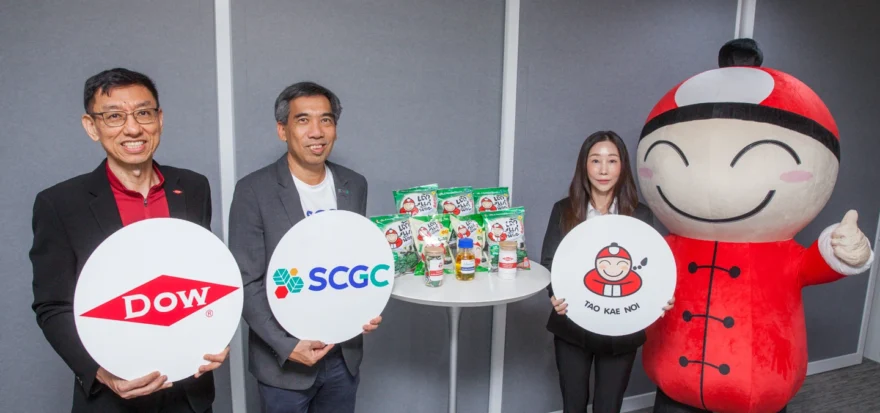
Bangkok – 25 February 2026: Marking the first-ever collaboration of three industry leaders, Taokaenoi Food & Marketing Public Company Limited, or TKN, a manufacturer of seaweed snacks distributed domestically and internationally, SCG Chemicals, or SCGC, a leading integrated polymer and solutions provider for sustainability, and Dow Thailand Group, or Dow, a global leader in materials science, have jointly announced the signing of a landmark Memorandum of Understanding (MoU) to revolutionize the snack industry through the “Food-Grade Circular Packaging by Advanced Recycling Technology” project. This initiative aims to sustainably address plastic waste challenges under the concept of closed-loop recycling. This collaboration entails utilizing multi-layer packaging waste from the production processes of Taokaenoi, which was previously difficult to recycle. This waste will be processed using the advanced recycling technology of SCGC and converted back into circular feedstock. Following this, Dow will utilize the feedstock to produce new, clean, and food-grade plastic resins. These resins will then be safely used to manufacture food packaging for the Taokaenoi brand once again. It is anticipated that the packaging will be ready for commercial distribution by the end of 2026. Ms. Orrapat Peeradechapan, Chief Executive Officer of Taokaenoi Food & Marketing Public Company Limited, said, “Taokaenoi is committed to creating happiness for consumers through high-quality snacks, alongside prioritizing ESG (Environmental, Social, and Governance) principles by emphasizing sustainable economic, social, and environmental development. This collaboration represents a significant milestone that transforms the ‘challenge’ of hard-to-recycle packaging into an ‘opportunity’ to establish a practical circular economy. It is not merely about waste disposal, but rather about creating new value from used plastic. We do not only deliver great-tasting products, but we also aim to deliver a better world to consumers through eco-friendly packaging innovations that are clean, safe, and tangibly reduce environmental impacts. This will drive our business to grow alongside genuine sustainability.” Dr. Suracha Udomsak, Chief Operations and Innovation Officer of SCGC, said, “This collaboration reflects the capability of SCGC in utilizing advanced recycling technology to manage plastic packaging composed of multiple materials, which is difficult to recycle, and converting it back into circular feedstock. This feedstock can be used to produce new plastic resins (Certified Circular Polyolefin Resin), which possess properties and quality entirely equivalent to standard virgin plastic resins in all respects and are safe for direct food contact. As a result, the materials can be reused to manufacture food packaging for Taokaenoi. In addition, our process has achieved the globally recognized sustainability certification, ISCC PLUS (International Sustainability and Carbon Certification), throughout the entire supply chain, making SCGC the first company in ASEAN to achieve such certification. This partnership is considered a crucial step in driving SCGC’s goal of reintegrating used plastic into the circular economy system at a volume of 500,000 tons per year by 2030, through collaborations with business partners across the entire value chain.” Meanwhile, Mr. Vichan Tangkengsirisin, President of Dow Thailand, added, “As a materials science leader, Dow is proud to support this collaboration in Thailand by applying our technology to produce circular plastic resins from used flexible packaging feedstock with performance equivalent to fossil-based plastics. Dow Thailand Group’s polyethylene facility in Rayong is ISCC PLUS certified for its capability of converting advanced recycled feedstock into high quality, food grade circular resins. This initiative represents an important step toward closing the plastics loop in Thailand and advancing Dow’s sustainability ambition to transform the waste through collaboration with customers and value chain partners.” This collaboration serves as a model for the comprehensive management of used multi-layer plastic packaging. It reduces the accumulation of plastic waste in the country and decreases the consumption of new resources. This aligns with the sustainability goals of Taokaenoi, SCGC, and Dow, reinforcing the role of the business sector in tangibly driving the circular economy to build a sustainable future together.
Year 2021
June 2021

Sweden's Oatly set to expand plant-based milk retail in China

10 June 2021 – Shanghai – Oatly, the world’s largest oat milk producer, said it will further expand its retail channels in China given the market’s growing potential and strategic importance.

At present, Oatly products are available at over 6,000 brick-and-mortar stores and 11,000 cafes in China.

China now accounts for 13 percent of Oatly’s total revenue since the company stepped into the market in 2018, with the compound annual growth rate of 45 percent.

On May 20, the Swedish company debuted on Nasdaq with IPO share price of $17, and when its intraday price surged to $22, its market value reached roughly $13 billion.

The plant-based dairy producer, which has been in the sector for 25 years, saw its global income for 2020 spike 106 percent year-on-year to exceed $420 million, according to the company’s prospectus.

In late 2016, Chinese conglomerate China Resources Holding Co Ltd formed a joint venture with Belgium consumer-focused investment company Verlinvest and acquired a 30 percent stake in Oatly, which then helped Oatly enter over 2,000 boutique cafes in China in 18 months.

Verlinvest’s network and experience in China have helped Oatly to establish its presence in the country and expand it later, said Raphael Thiolon, executive director of Verlinvest.

As Thiolon explained, oat milk takes up nearly 70 percent of the plant-based dairy market share in Sweden, while the corresponding figure is 40 percent throughout Europe and 14 percent in the United States. However, the number is less than 5 percent in China, which will point to more opportunities for Oatly.

Meanwhile, Chinese consumers now attach greater importance to healthier nutrition, cleaner products and natural functionality. These structural changes can all be translated into growth opportunities for innovative brands such as Oatly, said Thiolon.

“While most of the consumption of Oatly products happens in cafes, more efforts will be made to explore the retail channels in the next few years, to meet the needs of Chinese consumers in various scenarios,” he said.

The company’s prospectus stated that capacity is one possible factor dragging its development. Three new factories are now under construction, with one of them located in Maanshan of East China’s Anhui province.

Thiolon admitted that supply in China is still insufficient although Oatly has entered the market early given its strategic importance. But it is Oatly’s hope to set up plants extensively to meet consumer demand, which is also one of the major reasons for Oatly going public.

The global plant-based dairy sector posted a flat performance last year. According to market consultancy Euromonitor International, global milk market value reached $179 billion in 2020; and plant-based dairy brands accounted for only 9 percent of it.

However, the Chinese plant-based milk market burgeoned last year. A total of 15 financing deals with a combined value of over 1.56 billion yuan ($245 million) were reported in the sector in 2020, a record high.

Source: China Daily