


Featured Posts
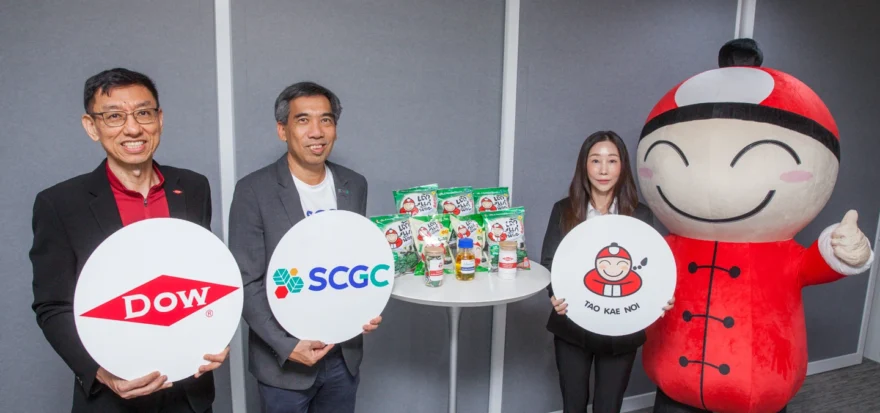
Bangkok – 25 February 2026: Marking the first-ever collaboration of three industry leaders, Taokaenoi Food & Marketing Public Company Limited, or TKN, a manufacturer of seaweed snacks distributed domestically and internationally, SCG Chemicals, or SCGC, a leading integrated polymer and solutions provider for sustainability, and Dow Thailand Group, or Dow, a global leader in materials science, have jointly announced the signing of a landmark Memorandum of Understanding (MoU) to revolutionize the snack industry through the “Food-Grade Circular Packaging by Advanced Recycling Technology” project. This initiative aims to sustainably address plastic waste challenges under the concept of closed-loop recycling. This collaboration entails utilizing multi-layer packaging waste from the production processes of Taokaenoi, which was previously difficult to recycle. This waste will be processed using the advanced recycling technology of SCGC and converted back into circular feedstock. Following this, Dow will utilize the feedstock to produce new, clean, and food-grade plastic resins. These resins will then be safely used to manufacture food packaging for the Taokaenoi brand once again. It is anticipated that the packaging will be ready for commercial distribution by the end of 2026. Ms. Orrapat Peeradechapan, Chief Executive Officer of Taokaenoi Food & Marketing Public Company Limited, said, “Taokaenoi is committed to creating happiness for consumers through high-quality snacks, alongside prioritizing ESG (Environmental, Social, and Governance) principles by emphasizing sustainable economic, social, and environmental development. This collaboration represents a significant milestone that transforms the ‘challenge’ of hard-to-recycle packaging into an ‘opportunity’ to establish a practical circular economy. It is not merely about waste disposal, but rather about creating new value from used plastic. We do not only deliver great-tasting products, but we also aim to deliver a better world to consumers through eco-friendly packaging innovations that are clean, safe, and tangibly reduce environmental impacts. This will drive our business to grow alongside genuine sustainability.” Dr. Suracha Udomsak, Chief Operations and Innovation Officer of SCGC, said, “This collaboration reflects the capability of SCGC in utilizing advanced recycling technology to manage plastic packaging composed of multiple materials, which is difficult to recycle, and converting it back into circular feedstock. This feedstock can be used to produce new plastic resins (Certified Circular Polyolefin Resin), which possess properties and quality entirely equivalent to standard virgin plastic resins in all respects and are safe for direct food contact. As a result, the materials can be reused to manufacture food packaging for Taokaenoi. In addition, our process has achieved the globally recognized sustainability certification, ISCC PLUS (International Sustainability and Carbon Certification), throughout the entire supply chain, making SCGC the first company in ASEAN to achieve such certification. This partnership is considered a crucial step in driving SCGC’s goal of reintegrating used plastic into the circular economy system at a volume of 500,000 tons per year by 2030, through collaborations with business partners across the entire value chain.” Meanwhile, Mr. Vichan Tangkengsirisin, President of Dow Thailand, added, “As a materials science leader, Dow is proud to support this collaboration in Thailand by applying our technology to produce circular plastic resins from used flexible packaging feedstock with performance equivalent to fossil-based plastics. Dow Thailand Group’s polyethylene facility in Rayong is ISCC PLUS certified for its capability of converting advanced recycled feedstock into high quality, food grade circular resins. This initiative represents an important step toward closing the plastics loop in Thailand and advancing Dow’s sustainability ambition to transform the waste through collaboration with customers and value chain partners.” This collaboration serves as a model for the comprehensive management of used multi-layer plastic packaging. It reduces the accumulation of plastic waste in the country and decreases the consumption of new resources. This aligns with the sustainability goals of Taokaenoi, SCGC, and Dow, reinforcing the role of the business sector in tangibly driving the circular economy to build a sustainable future together.
Year 2024
July 2024

Survey shows perception of cost as the main barrier to overcome in sustainable packaging

30 July 2024 – UPM, a leading renewable biomaterials supplier, has unveiled the latest findings from a highly targeted survey of some of the world’s leading packaging designers. The survey, conducted in collaboration with the Pentawards, has revealed unique insights into sustainable packaging design, including some of the key challenges faced by designers, with UPM highlighting how these can be overcome.

The survey results show that while the majority (47%) of the designer respondents feel extremely comfortable handling briefs that include sustainability requirements, 43% of packaging designers would prefer more direction or information to feel fully comfortable when dealing with these briefs. This highlights a need for further education on how to incorporate sustainability into packaging design, with most respondents (35%) suggesting material guides would be the most beneficial.

Further findings reveal that 57% of the designer respondents believe they always or often have the opportunity to impact the material choice of a product. However, 20% say they seldom do, and 17% almost never, which suggests some clients may not have yet realised the value of exploring alternative and more sustainable packaging solutions.

Despite many packaging designers striving to develop more sustainable packaging, price was highlighted as a key challenge by the majority of those surveyed. Although many of the designers acknowledged the importance of using sustainable materials for innovative packaging solutions, the cost frequently deterred their clients, leading many to choose the cheapest option instead. One respondent stated: “Everyone wants to be green, until they see that being green is usually more expensive”. While another noted: “I think the production end, or the manufacturers are not yet completely ready for this kind of change.”

Robert Taylor, Sustainability Director at UPM and member of the Pentawards jury, used a speaker opportunity at a recent Pentawards Meets closed event to discuss the findings in detail and address these challenges to help support designers and further drive sustainable innovation.

Commenting on the survey findings, Robert Taylor stated: “While cost has been highlighted as a barrier to embracing sustainable packaging design, it’s important to take a moment to consider what is the true cost of not doing so. We need a holistic approach that considers the value creation potential in a market that is growing twice as fast for sustainable products. This is especially key as the impact of new regulation and green finance kicks in, with carbon taxes, plastics taxes and Extended Producer Responsibility (EPR) fees just a few examples. Reducing packaging is one of the most effective ways to reduce impact and cost. Using less raw material, water and energy and generating less waste or having a more effective supply chains brings savings and reduces the environmental footprint.”

“As an industry, we need to understand the true cost of sustainable packaging design and embrace innovations that will help us meet the ambitious environmental targets set. We are faced with more climate, biodiversity and water crises across the globe every day but with only 15% of the Sustainable Development Goals (SDGs) on track to meet their target levels by 2030, not taking action towards improving sustainable packaging is simply not an option. We need to move forward faster.”

Adam Ryan, Head of Pentawards commented: “We’ve had some really interesting insights from the survey with UPM, our community was open in sharing challenges, improvements and their ways of working in sustainable design. It’s great to see that brands and agencies are now so willing to share insights and learnings which benefits the industry as a whole. Sustainability in design is continuously developing and it’s so important that we at Pentawards are part of this.”

Source: upmraflatac