
Featured Posts
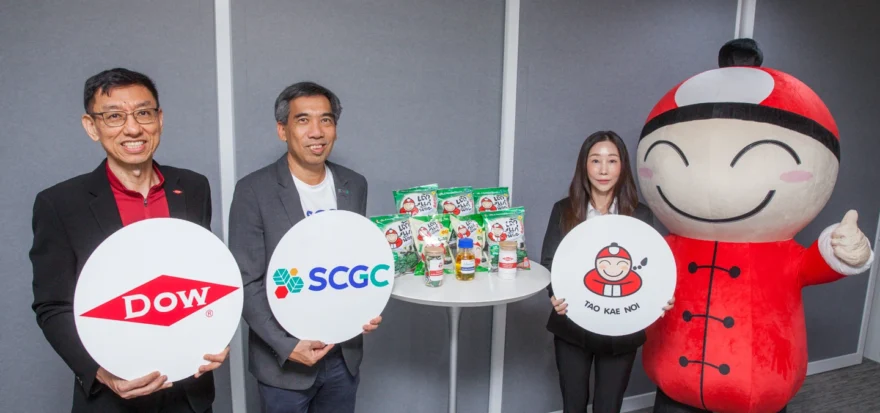
Bangkok – 25 February 2026: Marking the first-ever collaboration of three industry leaders, Taokaenoi Food & Marketing Public Company Limited, or TKN, a manufacturer of seaweed snacks distributed domestically and internationally, SCG Chemicals, or SCGC, a leading integrated polymer and solutions provider for sustainability, and Dow Thailand Group, or Dow, a global leader in materials science, have jointly announced the signing of a landmark Memorandum of Understanding (MoU) to revolutionize the snack industry through the “Food-Grade Circular Packaging by Advanced Recycling Technology” project. This initiative aims to sustainably address plastic waste challenges under the concept of closed-loop recycling. This collaboration entails utilizing multi-layer packaging waste from the production processes of Taokaenoi, which was previously difficult to recycle. This waste will be processed using the advanced recycling technology of SCGC and converted back into circular feedstock. Following this, Dow will utilize the feedstock to produce new, clean, and food-grade plastic resins. These resins will then be safely used to manufacture food packaging for the Taokaenoi brand once again. It is anticipated that the packaging will be ready for commercial distribution by the end of 2026. Ms. Orrapat Peeradechapan, Chief Executive Officer of Taokaenoi Food & Marketing Public Company Limited, said, “Taokaenoi is committed to creating happiness for consumers through high-quality snacks, alongside prioritizing ESG (Environmental, Social, and Governance) principles by emphasizing sustainable economic, social, and environmental development. This collaboration represents a significant milestone that transforms the ‘challenge’ of hard-to-recycle packaging into an ‘opportunity’ to establish a practical circular economy. It is not merely about waste disposal, but rather about creating new value from used plastic. We do not only deliver great-tasting products, but we also aim to deliver a better world to consumers through eco-friendly packaging innovations that are clean, safe, and tangibly reduce environmental impacts. This will drive our business to grow alongside genuine sustainability.” Dr. Suracha Udomsak, Chief Operations and Innovation Officer of SCGC, said, “This collaboration reflects the capability of SCGC in utilizing advanced recycling technology to manage plastic packaging composed of multiple materials, which is difficult to recycle, and converting it back into circular feedstock. This feedstock can be used to produce new plastic resins (Certified Circular Polyolefin Resin), which possess properties and quality entirely equivalent to standard virgin plastic resins in all respects and are safe for direct food contact. As a result, the materials can be reused to manufacture food packaging for Taokaenoi. In addition, our process has achieved the globally recognized sustainability certification, ISCC PLUS (International Sustainability and Carbon Certification), throughout the entire supply chain, making SCGC the first company in ASEAN to achieve such certification. This partnership is considered a crucial step in driving SCGC’s goal of reintegrating used plastic into the circular economy system at a volume of 500,000 tons per year by 2030, through collaborations with business partners across the entire value chain.” Meanwhile, Mr. Vichan Tangkengsirisin, President of Dow Thailand, added, “As a materials science leader, Dow is proud to support this collaboration in Thailand by applying our technology to produce circular plastic resins from used flexible packaging feedstock with performance equivalent to fossil-based plastics. Dow Thailand Group’s polyethylene facility in Rayong is ISCC PLUS certified for its capability of converting advanced recycled feedstock into high quality, food grade circular resins. This initiative represents an important step toward closing the plastics loop in Thailand and advancing Dow’s sustainability ambition to transform the waste through collaboration with customers and value chain partners.” This collaboration serves as a model for the comprehensive management of used multi-layer plastic packaging. It reduces the accumulation of plastic waste in the country and decreases the consumption of new resources. This aligns with the sustainability goals of Taokaenoi, SCGC, and Dow, reinforcing the role of the business sector in tangibly driving the circular economy to build a sustainable future together.
Year 2020
September 2020

Sumitomo (SHI) Demag reports machine order increase during corona crisis

The face of Sumitomo (SHI) Demag: Henrik Langwald, Paolo Zirondoli, Anatol Sattel, Jürgen Schulze, Arnaud Nomblot, Gerd Liebig, Siegfried Köhler, Thorsten Thümen (left to right)

18 Aug 2020 – Compared with the first half of 2019, injection moulding machine manufacturer Sumitomo (SHI) Demag is ending the first half of 2020 with a healthy order book. During the first six months, the value of incoming orders for machines produced in Germany rose by almost 25 percent.

Cautiously optimistic for the future, CEO Gerd Liebig provides some context behind the healthy growth curve, which he predominantly attributes to orders placed by the packaging and medical technology sectors.” Our intentional strategic focus on these two growth markets over the past few years has placed us in a stronger position, helping us to survive during these difficult times with a strong order increase“.

As with the entire plastics industry, demand from the automotive industry has slumped sharply for the Japanese-German manufacturer of injection moulding machines. The Group’s forecast for the consumer segment is also rather cautious: Due to the tense situation on the labour market and the declining propensity of consumers to buy, the company anticipates a lower inclination among moulders to invest. In contrast, the packaging and medical segments are developing very positively this year, and demand for all-electric machines is also rising sharply. “To cope with the increase in orders, we are utilising all available resources and increasing production capacities in our IntElect series considerably. ” Liebig continues.

As a result of stable sales, Sumitomo (SHI) Demag expects to report a year-on-year 17 percent increase in overall incoming orders for 2020. “Our plant in Wiehe is operating at full capacity and from November 2020 we will be producing the all-electric small machines at the historic high cycle. The strategic focus on this series is now paying off in full: By the second half of 2020, we will double our production capacity once again in order to meet demand,” says Gerd Liebig.

As a result of this increase, Sumitomo (SHI) Demag is pushing ahead with the planned cooperation with its Japanese parent company, with Japan commencing production of IntElect machines later in 2020.