
Featured Posts
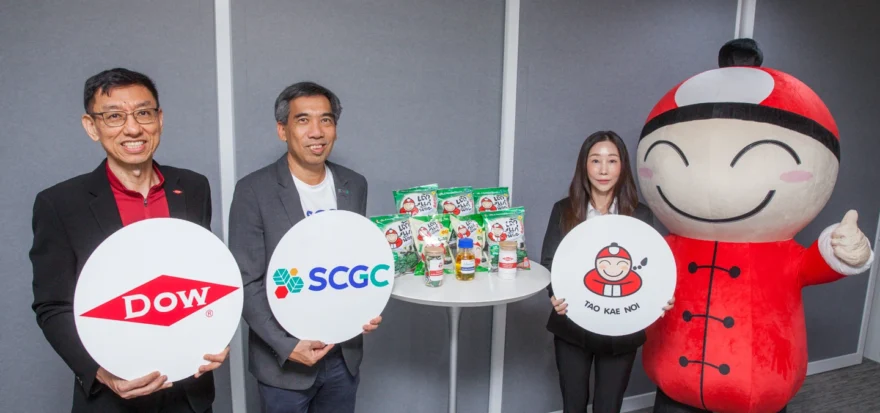
Bangkok – 25 February 2026: Marking the first-ever collaboration of three industry leaders, Taokaenoi Food & Marketing Public Company Limited, or TKN, a manufacturer of seaweed snacks distributed domestically and internationally, SCG Chemicals, or SCGC, a leading integrated polymer and solutions provider for sustainability, and Dow Thailand Group, or Dow, a global leader in materials science, have jointly announced the signing of a landmark Memorandum of Understanding (MoU) to revolutionize the snack industry through the “Food-Grade Circular Packaging by Advanced Recycling Technology” project. This initiative aims to sustainably address plastic waste challenges under the concept of closed-loop recycling. This collaboration entails utilizing multi-layer packaging waste from the production processes of Taokaenoi, which was previously difficult to recycle. This waste will be processed using the advanced recycling technology of SCGC and converted back into circular feedstock. Following this, Dow will utilize the feedstock to produce new, clean, and food-grade plastic resins. These resins will then be safely used to manufacture food packaging for the Taokaenoi brand once again. It is anticipated that the packaging will be ready for commercial distribution by the end of 2026. Ms. Orrapat Peeradechapan, Chief Executive Officer of Taokaenoi Food & Marketing Public Company Limited, said, “Taokaenoi is committed to creating happiness for consumers through high-quality snacks, alongside prioritizing ESG (Environmental, Social, and Governance) principles by emphasizing sustainable economic, social, and environmental development. This collaboration represents a significant milestone that transforms the ‘challenge’ of hard-to-recycle packaging into an ‘opportunity’ to establish a practical circular economy. It is not merely about waste disposal, but rather about creating new value from used plastic. We do not only deliver great-tasting products, but we also aim to deliver a better world to consumers through eco-friendly packaging innovations that are clean, safe, and tangibly reduce environmental impacts. This will drive our business to grow alongside genuine sustainability.” Dr. Suracha Udomsak, Chief Operations and Innovation Officer of SCGC, said, “This collaboration reflects the capability of SCGC in utilizing advanced recycling technology to manage plastic packaging composed of multiple materials, which is difficult to recycle, and converting it back into circular feedstock. This feedstock can be used to produce new plastic resins (Certified Circular Polyolefin Resin), which possess properties and quality entirely equivalent to standard virgin plastic resins in all respects and are safe for direct food contact. As a result, the materials can be reused to manufacture food packaging for Taokaenoi. In addition, our process has achieved the globally recognized sustainability certification, ISCC PLUS (International Sustainability and Carbon Certification), throughout the entire supply chain, making SCGC the first company in ASEAN to achieve such certification. This partnership is considered a crucial step in driving SCGC’s goal of reintegrating used plastic into the circular economy system at a volume of 500,000 tons per year by 2030, through collaborations with business partners across the entire value chain.” Meanwhile, Mr. Vichan Tangkengsirisin, President of Dow Thailand, added, “As a materials science leader, Dow is proud to support this collaboration in Thailand by applying our technology to produce circular plastic resins from used flexible packaging feedstock with performance equivalent to fossil-based plastics. Dow Thailand Group’s polyethylene facility in Rayong is ISCC PLUS certified for its capability of converting advanced recycled feedstock into high quality, food grade circular resins. This initiative represents an important step toward closing the plastics loop in Thailand and advancing Dow’s sustainability ambition to transform the waste through collaboration with customers and value chain partners.” This collaboration serves as a model for the comprehensive management of used multi-layer plastic packaging. It reduces the accumulation of plastic waste in the country and decreases the consumption of new resources. This aligns with the sustainability goals of Taokaenoi, SCGC, and Dow, reinforcing the role of the business sector in tangibly driving the circular economy to build a sustainable future together.
Year 2025
May 2025

SIG launches aluminium-layer-free full barrier solution for multi-serve aseptic cartons

24 May 2025 – SIG announced the commercial launch of SIG Terra Alu-free + Full barrier for multi-serve aseptic cartons. Building on the success of this groundbreaking packaging material innovation in the field of single-serve cartons – with over 300 million packs sold in China since 2023 – SIG is scaling up the world’s first, aluminum-layer-free full-barrier packaging material to multi-serve aseptic cartons and ready to provide it at scale to customers around the globe.

The packaging structure for multi-serve cartons with no aluminum layer cuts the carbon footprint of SIG’s standard aseptic cartons by up to 61%1 when combined with forest-based polymers2. Made of more than 80% paper, the material simplifies the packaging structure to only two main raw materials, that can all be linked to renewable sources.

Performance and compatibility

According to SIG, the packaging material offers the same full barrier protection as standard aseptic cartons and the same full shelf life of up to 12 months. It can seamlessly run on existing SIG carton filling lines with full performance including high-speed of up to 24,000 packs per hour on SIG filling lines for small-size cartons and up to 15,000 packs per hour on filling lines for multi-serve cartons with only minor, low-cost adaptations. The plug-and-play solution is enabling SIG customers worldwide to make use of the additional environmental benefits that come with the alu layer-free full barrier packaging material suitable for a wide range of beverages without compromising product quality or production performance.

“At SIG, we are leading the industry transition to alu-layer-free aseptic carton packaging materials. With our full barrier material with no aluminum layer, we are offering a powerful differentiator and embodiment of sustainability in aseptic carton packaging, unlocking new opportunities for packaging sensitive product categories such as plant-based products, juices, and nutritional beverages. As a result, our SIG Terra portfolio now offers an aseptic carton solution without aluminum layer for all product categories we serve, without compromising on shelf life”, said Christoph Wegener, Chief Markets Officer at SIG.

Decarbonizing the food and beverage industry is more important than ever. In aseptic cartons, an aluminum layer is traditionally used to protect food and beverage products from oxygen and light. Although aluminum accounts for just around 5% of a standard aseptic carton, it accounts for up to 25% of its carbon footprint in a full-barrier package. Removing the aluminum layer is a significant step in reducing the already low carbon footprint of standard SIG aseptic cartons even further and simplifies the packaging structure from 3 to just 2 main raw materials, thereby increasing the share of paper to over 80%.

Since launching the first alu-layer-free aseptic carton in 2010, SIG has sold over 4 billion packs featuring no aluminum layer, including 300 million alu-free full-barrier cartons. These milestones reinforce SIG’s leadership in sustainable aseptic packaging.

Gavin Steiner, Chief Technology Officer at SIG: “Sustainability is integral to our business, and we strive to create a regenerative food packaging system. Looking ahead, SIG plans to raise the paper content in its aseptic cartons to at least 90% including closures by 2030, with an interim target of 85% without closure this year – further boosting renewability, lowering carbon footprints, and with the potential to streamline the recycling process for aseptic cartons, only requiring the separation of paperboard and polymers.”