
Featured Posts
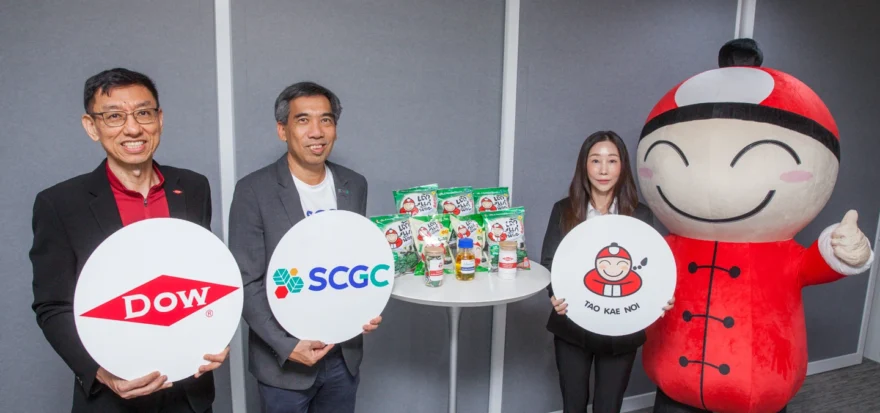
Bangkok – 25 February 2026: Marking the first-ever collaboration of three industry leaders, Taokaenoi Food & Marketing Public Company Limited, or TKN, a manufacturer of seaweed snacks distributed domestically and internationally, SCG Chemicals, or SCGC, a leading integrated polymer and solutions provider for sustainability, and Dow Thailand Group, or Dow, a global leader in materials science, have jointly announced the signing of a landmark Memorandum of Understanding (MoU) to revolutionize the snack industry through the “Food-Grade Circular Packaging by Advanced Recycling Technology” project. This initiative aims to sustainably address plastic waste challenges under the concept of closed-loop recycling. This collaboration entails utilizing multi-layer packaging waste from the production processes of Taokaenoi, which was previously difficult to recycle. This waste will be processed using the advanced recycling technology of SCGC and converted back into circular feedstock. Following this, Dow will utilize the feedstock to produce new, clean, and food-grade plastic resins. These resins will then be safely used to manufacture food packaging for the Taokaenoi brand once again. It is anticipated that the packaging will be ready for commercial distribution by the end of 2026. Ms. Orrapat Peeradechapan, Chief Executive Officer of Taokaenoi Food & Marketing Public Company Limited, said, “Taokaenoi is committed to creating happiness for consumers through high-quality snacks, alongside prioritizing ESG (Environmental, Social, and Governance) principles by emphasizing sustainable economic, social, and environmental development. This collaboration represents a significant milestone that transforms the ‘challenge’ of hard-to-recycle packaging into an ‘opportunity’ to establish a practical circular economy. It is not merely about waste disposal, but rather about creating new value from used plastic. We do not only deliver great-tasting products, but we also aim to deliver a better world to consumers through eco-friendly packaging innovations that are clean, safe, and tangibly reduce environmental impacts. This will drive our business to grow alongside genuine sustainability.” Dr. Suracha Udomsak, Chief Operations and Innovation Officer of SCGC, said, “This collaboration reflects the capability of SCGC in utilizing advanced recycling technology to manage plastic packaging composed of multiple materials, which is difficult to recycle, and converting it back into circular feedstock. This feedstock can be used to produce new plastic resins (Certified Circular Polyolefin Resin), which possess properties and quality entirely equivalent to standard virgin plastic resins in all respects and are safe for direct food contact. As a result, the materials can be reused to manufacture food packaging for Taokaenoi. In addition, our process has achieved the globally recognized sustainability certification, ISCC PLUS (International Sustainability and Carbon Certification), throughout the entire supply chain, making SCGC the first company in ASEAN to achieve such certification. This partnership is considered a crucial step in driving SCGC’s goal of reintegrating used plastic into the circular economy system at a volume of 500,000 tons per year by 2030, through collaborations with business partners across the entire value chain.” Meanwhile, Mr. Vichan Tangkengsirisin, President of Dow Thailand, added, “As a materials science leader, Dow is proud to support this collaboration in Thailand by applying our technology to produce circular plastic resins from used flexible packaging feedstock with performance equivalent to fossil-based plastics. Dow Thailand Group’s polyethylene facility in Rayong is ISCC PLUS certified for its capability of converting advanced recycled feedstock into high quality, food grade circular resins. This initiative represents an important step toward closing the plastics loop in Thailand and advancing Dow’s sustainability ambition to transform the waste through collaboration with customers and value chain partners.” This collaboration serves as a model for the comprehensive management of used multi-layer plastic packaging. It reduces the accumulation of plastic waste in the country and decreases the consumption of new resources. This aligns with the sustainability goals of Taokaenoi, SCGC, and Dow, reinforcing the role of the business sector in tangibly driving the circular economy to build a sustainable future together.
Year 2020
March 2020

New Zealand's a2 Milk Co sales surge in China

Feb 28 2020 – New Zealand’s a2 Milk Co Ltd on Thursday unveiled a 21% rise in half-year profit. Sales of its China label infant formula products doubled ahead of expectations in January and February.

“The reality is that those increased sales are a result of the impact of the coronavirus on a product such as ours, which is not discretionary. Where we clearly have a strong brand franchise, where people have a view as to the high quality of the product,” a2 Milk chief executive Geoff Babidge said.

The Auckland-headquartered company said that it was pleased its investments to deepen understanding of consumer and channel trends and the increased levels of investment in marketing and capability development are translating into accelerated growth in its China label business.

Its half-year net profit of NZ$184.9 million ($116.73 million) was driven by doubling sales in China of infant nutrition products marketed under its own brand, while expansion in the United States likewise led to a doubling in milk revenue there.

Mr Babidge said there is no way to tell if the higher sales in the second half are due to new mothers trying the a2 Platinum brand or to more consumers stockpiling essential items, or both.

“Online and reseller and daigou channels are also performing strongly into the market at this time. How that plays out in coming months and whether that trend will continue, or be offset in months to come is clearly very difficult to predict.”

The company recorded an EBITDA (earnings before interest, tax, depreciation and amortisation) margin of 32.6 per cent, which it said was “better than expected”.  a2 said it was expecting “continued strong revenue growth” in the current financial year, and that full year EBITDA margin was expected to be 29-30 per cent.

Mr Babidge returned to the role of CEO on an interim basis late last year following the unexpected departure of former CEO Jayne Hrdlicka.

Ophir Asset Management Director Andrew Mitchell said a2 is perceived as a very high quality brand in China and its products have inelastic demand.

“We are not surprised that a2 Milk is seeing increasing demand due to COVID-19, given it has the most flexible channels to market and is therefore positioned to take share from competitors who may rely on domestic manufacturing or single sales channels,” he said.

Fonterra Co-Operative Group – a key partner of a2 Milk – said on Thursday the “current situation is very fluid and uncertain” and it has already contracted a high percentage of 2020 financial year’s milk supply to help manage impacts of coronavirus.

Market Expansion
In October last year, the company, supported by its distribution partner – China State Farm, launched infant formula in the city of Hong Kong and in December, launched infant formula in Korea along with local partner, YuhanCARE (Yuhan).