
Featured Posts
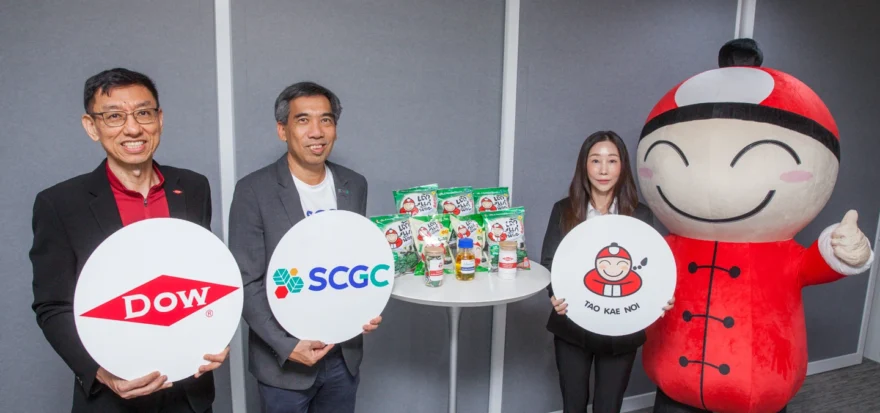
Bangkok – 25 February 2026: Marking the first-ever collaboration of three industry leaders, Taokaenoi Food & Marketing Public Company Limited, or TKN, a manufacturer of seaweed snacks distributed domestically and internationally, SCG Chemicals, or SCGC, a leading integrated polymer and solutions provider for sustainability, and Dow Thailand Group, or Dow, a global leader in materials science, have jointly announced the signing of a landmark Memorandum of Understanding (MoU) to revolutionize the snack industry through the “Food-Grade Circular Packaging by Advanced Recycling Technology” project. This initiative aims to sustainably address plastic waste challenges under the concept of closed-loop recycling. This collaboration entails utilizing multi-layer packaging waste from the production processes of Taokaenoi, which was previously difficult to recycle. This waste will be processed using the advanced recycling technology of SCGC and converted back into circular feedstock. Following this, Dow will utilize the feedstock to produce new, clean, and food-grade plastic resins. These resins will then be safely used to manufacture food packaging for the Taokaenoi brand once again. It is anticipated that the packaging will be ready for commercial distribution by the end of 2026. Ms. Orrapat Peeradechapan, Chief Executive Officer of Taokaenoi Food & Marketing Public Company Limited, said, “Taokaenoi is committed to creating happiness for consumers through high-quality snacks, alongside prioritizing ESG (Environmental, Social, and Governance) principles by emphasizing sustainable economic, social, and environmental development. This collaboration represents a significant milestone that transforms the ‘challenge’ of hard-to-recycle packaging into an ‘opportunity’ to establish a practical circular economy. It is not merely about waste disposal, but rather about creating new value from used plastic. We do not only deliver great-tasting products, but we also aim to deliver a better world to consumers through eco-friendly packaging innovations that are clean, safe, and tangibly reduce environmental impacts. This will drive our business to grow alongside genuine sustainability.” Dr. Suracha Udomsak, Chief Operations and Innovation Officer of SCGC, said, “This collaboration reflects the capability of SCGC in utilizing advanced recycling technology to manage plastic packaging composed of multiple materials, which is difficult to recycle, and converting it back into circular feedstock. This feedstock can be used to produce new plastic resins (Certified Circular Polyolefin Resin), which possess properties and quality entirely equivalent to standard virgin plastic resins in all respects and are safe for direct food contact. As a result, the materials can be reused to manufacture food packaging for Taokaenoi. In addition, our process has achieved the globally recognized sustainability certification, ISCC PLUS (International Sustainability and Carbon Certification), throughout the entire supply chain, making SCGC the first company in ASEAN to achieve such certification. This partnership is considered a crucial step in driving SCGC’s goal of reintegrating used plastic into the circular economy system at a volume of 500,000 tons per year by 2030, through collaborations with business partners across the entire value chain.” Meanwhile, Mr. Vichan Tangkengsirisin, President of Dow Thailand, added, “As a materials science leader, Dow is proud to support this collaboration in Thailand by applying our technology to produce circular plastic resins from used flexible packaging feedstock with performance equivalent to fossil-based plastics. Dow Thailand Group’s polyethylene facility in Rayong is ISCC PLUS certified for its capability of converting advanced recycled feedstock into high quality, food grade circular resins. This initiative represents an important step toward closing the plastics loop in Thailand and advancing Dow’s sustainability ambition to transform the waste through collaboration with customers and value chain partners.” This collaboration serves as a model for the comprehensive management of used multi-layer plastic packaging. It reduces the accumulation of plastic waste in the country and decreases the consumption of new resources. This aligns with the sustainability goals of Taokaenoi, SCGC, and Dow, reinforcing the role of the business sector in tangibly driving the circular economy to build a sustainable future together.
Year 2020
August 2020

Master Kong’s aseptic PET lines’ cost predictability and efficiency improved with Sidel’s maintenance services
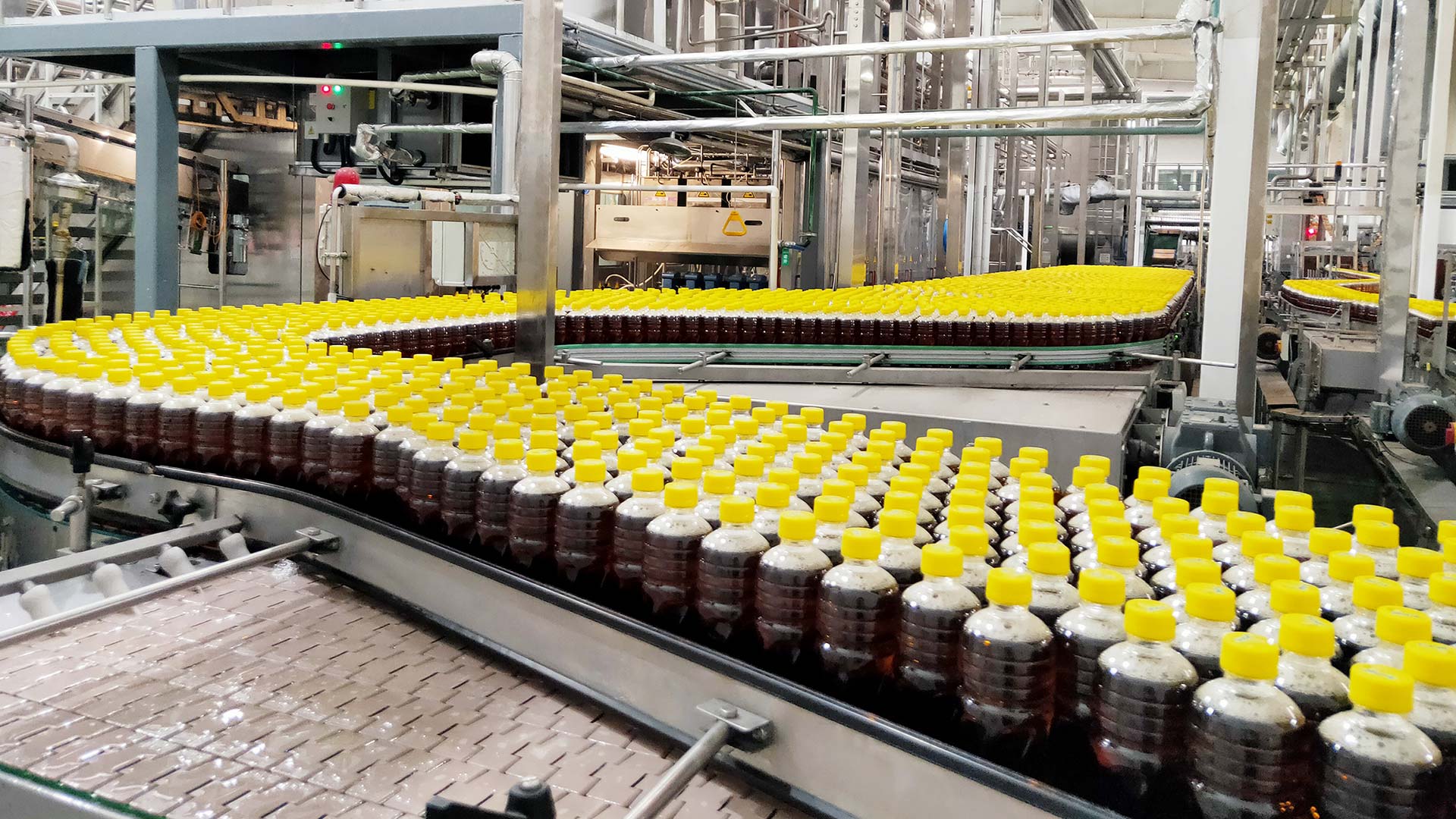
In 2019, Master Kong beverage (Master Kong) in China opted to sign a two-year fixed price maintenance contract with Sidel for four of their aseptic complete PET lines producing ready-to-drink (RTD) teas in their plants in Langfang and Baotou. Sidel’s proactive maintenance and on-site support have contributed to Master Kong’s business during the peak season by better controlling maintenance costs while improving the lines’ efficiency by 6%.

The beginning of Master Kong’s and Sidel’s partnership dates back more than 15 years when the first of several packaging lines for Water, CSD, and JNSDIT were installed by Sidel. After several years of operation of the aseptic PET packaging lines, the leading RTD tea producer in China were considering maintenance services. The objective was to keep the maintenance costs predictable for two lines running in the Baotou plant since 2012 and for two others in the Langfang plant since 2013.

Shift to a proactive maintenance pays off
In the past, Master Kong did reactive maintenance, purchasing spare parts only when needed, which generated unplanned downtime and costs. Christina Xu, services account director for Greater China at Sidel, pointed out that the new maintenance contract showed the advantages of shifting to a more proactive maintenance, addressing Master Kong’s requirement in maintenance to extend aseptic PET lines’ lifetime, running at 48,00 bottles per hour.

Wang Wei, head of product planning supply chain management – operation department, Master Kong, added: “Sidel has been a reliable partner, convincingly demonstrating an in-depth knowledge of aseptic PET packaging. Not least, it remains important to us to have them as our OEM [original equipment manufacturer], providing us with consistent equipment and services as well as advice on demand. The service contract definitely answers all our needs.”

Control costs and increase uptime
To define the appropriate maintenance service solution for the customer from the onset, the Sidel team compared Master Kong’s yearly average maintenance and spare parts storage expenses with the traditional expenses related to the effective operation of the aseptic lines. Therefore, the contract ensures better cost control providing a clearer view of maintenance expenses with specified fixed costs based on the number of running hours. Additionally, the spare part orders, stipulated in the contract, helped to optimise cash flow by reducing inventory costs for spare parts.

Sidel have been providing scheduling and execution of preventive and corrective maintenance. Their analysis and reports enabled Master Kong to accurately monitor the lines and maximise their uptime. The aseptic validation process, included in the contract and passed right after the maintenance, secured product safety Master Kong were aiming for.

Close and successful partnership with long-term ambitions
The first year of maintenance execution was accomplished by the end of 2019, and the collaboration between Sidel and Master Kong allowed to refill the spare parts stock and run the necessary diagnostics in less than two months, Xu reported.

The partnership during the maintenance process was organised in quarterly and monthly on-site meetings as well as regular follow-up. Furthermore, Sidel provided on-site technical coaching to optimise operations, and Wang concluded: “From a production point of view, we are really happy that Sidel’s local technicians were able to continuously train our employees on-site to optimise operations on our machines. Additionally, we could also rely on a key safety stock of 100% original Sidel spare parts, securing machine uptime and generating further savings.”

Last December, Master Kong signed another maintenance contract with Sidel for additional five aseptic PET packaging lines and four blowers in the Chengdu plant, and has planned to extend Sidel’s maintenance service across other plants.