
Featured Posts
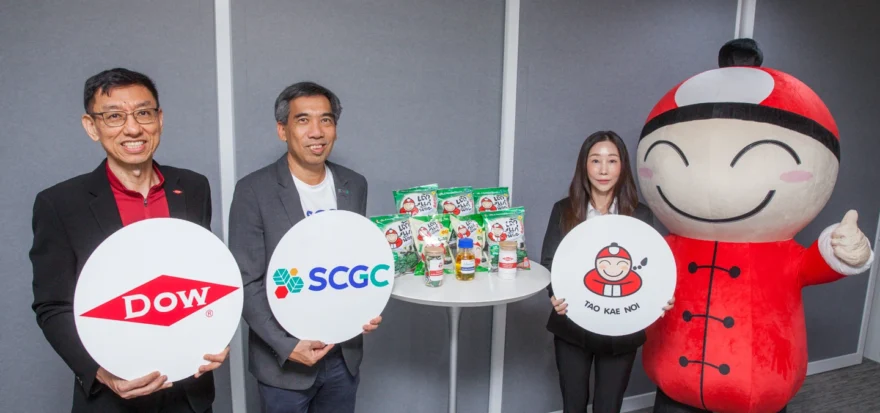
Bangkok – 25 February 2026: Marking the first-ever collaboration of three industry leaders, Taokaenoi Food & Marketing Public Company Limited, or TKN, a manufacturer of seaweed snacks distributed domestically and internationally, SCG Chemicals, or SCGC, a leading integrated polymer and solutions provider for sustainability, and Dow Thailand Group, or Dow, a global leader in materials science, have jointly announced the signing of a landmark Memorandum of Understanding (MoU) to revolutionize the snack industry through the “Food-Grade Circular Packaging by Advanced Recycling Technology” project. This initiative aims to sustainably address plastic waste challenges under the concept of closed-loop recycling. This collaboration entails utilizing multi-layer packaging waste from the production processes of Taokaenoi, which was previously difficult to recycle. This waste will be processed using the advanced recycling technology of SCGC and converted back into circular feedstock. Following this, Dow will utilize the feedstock to produce new, clean, and food-grade plastic resins. These resins will then be safely used to manufacture food packaging for the Taokaenoi brand once again. It is anticipated that the packaging will be ready for commercial distribution by the end of 2026. Ms. Orrapat Peeradechapan, Chief Executive Officer of Taokaenoi Food & Marketing Public Company Limited, said, “Taokaenoi is committed to creating happiness for consumers through high-quality snacks, alongside prioritizing ESG (Environmental, Social, and Governance) principles by emphasizing sustainable economic, social, and environmental development. This collaboration represents a significant milestone that transforms the ‘challenge’ of hard-to-recycle packaging into an ‘opportunity’ to establish a practical circular economy. It is not merely about waste disposal, but rather about creating new value from used plastic. We do not only deliver great-tasting products, but we also aim to deliver a better world to consumers through eco-friendly packaging innovations that are clean, safe, and tangibly reduce environmental impacts. This will drive our business to grow alongside genuine sustainability.” Dr. Suracha Udomsak, Chief Operations and Innovation Officer of SCGC, said, “This collaboration reflects the capability of SCGC in utilizing advanced recycling technology to manage plastic packaging composed of multiple materials, which is difficult to recycle, and converting it back into circular feedstock. This feedstock can be used to produce new plastic resins (Certified Circular Polyolefin Resin), which possess properties and quality entirely equivalent to standard virgin plastic resins in all respects and are safe for direct food contact. As a result, the materials can be reused to manufacture food packaging for Taokaenoi. In addition, our process has achieved the globally recognized sustainability certification, ISCC PLUS (International Sustainability and Carbon Certification), throughout the entire supply chain, making SCGC the first company in ASEAN to achieve such certification. This partnership is considered a crucial step in driving SCGC’s goal of reintegrating used plastic into the circular economy system at a volume of 500,000 tons per year by 2030, through collaborations with business partners across the entire value chain.” Meanwhile, Mr. Vichan Tangkengsirisin, President of Dow Thailand, added, “As a materials science leader, Dow is proud to support this collaboration in Thailand by applying our technology to produce circular plastic resins from used flexible packaging feedstock with performance equivalent to fossil-based plastics. Dow Thailand Group’s polyethylene facility in Rayong is ISCC PLUS certified for its capability of converting advanced recycled feedstock into high quality, food grade circular resins. This initiative represents an important step toward closing the plastics loop in Thailand and advancing Dow’s sustainability ambition to transform the waste through collaboration with customers and value chain partners.” This collaboration serves as a model for the comprehensive management of used multi-layer plastic packaging. It reduces the accumulation of plastic waste in the country and decreases the consumption of new resources. This aligns with the sustainability goals of Taokaenoi, SCGC, and Dow, reinforcing the role of the business sector in tangibly driving the circular economy to build a sustainable future together.
Year 2023
April 2023

Kuraray showcases bio-circular EVAL™ EVOH as well as global innovation initiative at Interpack

17 April 2023 Hattersheim/Frankfurt am Main – Kuraray will be showcasing its bio-circular and recyclable EVOH “EVAL™”, a barrier resin widely used for e.g. food packaging at Interpack (May 4-10, 2023, Düsseldorf). The Kuraray EVAL Europe N.V. plant enables the market introduction of EVOH from renewable resources – a fact also confirmed by its recent ISCC PLUS certification. Furthermore, to promote innovation globally and across the entire product portfolio.

At Kuraray’s booth (Hall 10, D63) visitors will have the opportunity to experience the excellent gas barrier performance of EVAL™. Avoiding oxygen-induced degradation in food, EVAL™ extends the product’s shelf life and quality. At the same time, it blocks contaminants from migrating into the packaging. This unique double function makes EVAL™ the ideal material for film packaging of perishable foodstuffs, as aroma preservation or as an efficient functional barrier for organic solvents or potential contaminants, such as those that might be present in food cartons made of recycled corrugated board or post-consumer recycled plastics. In addition, EVAL™ with metallization protects Active Pharmaceutical Ingredients (API), offering a barrier against water, light, oxygen, CO2 and chemicals, which makes the resin also suitable for the packaging of sensitive content such as medicines. For the most sensitive applications, the unique oxygen scavenging EVAL™ EVOH adds extra safety and potentially reduces further oxygen ingress to zero. Kuraray is a global leader in the production and development of EVAL™ EVOH barrier resins and films. Greater sustainability and recyclability are explicit requirements of Kuraray’s customers in the food, cosmetic or health care industry.

Recyclable mono-material solution

EVAL™ EVOH with a thickness of only 1 mm has the same gas barrier as a 10-meter-thick wall of LDPE. With such performance, a very thin layer of EVAL™ EVOH adds a superior barrier to efficient multilayer structures, making it possible for these multilayer structures to provide functional protection using a minimum amount of material. This way, the packaging weighs less and still protects the product and the environment. What is more: due to the minimal amount of EVAL™ needed, packers can use the resin with polyolefins – such as polyethylene – to create a package that will still be considered mono-material and fits well into the recycling stream. Only recently, EVAL™ has received ISCC PLUS certification, proving its bio-circular properties. This makes EVAL™ the natural solution for users e.g. in the food packaging industry, as it allows safe packaging and recyclability at the same time.

First ISCC PLUS Certification for Bio-Circular EVAL™

International Sustainability & Carbon Certification, ISCC, is a leading global certification system that covers all sustainable raw materials, including agricultural and forestry biomass, biogenic waste, recycled materials, and renewable energy. ISCC PLUS Renewable Resource certification supports the use of bio and circular feedstocks, also accepting the mass balance approach. Its purpose is to document the proportion of bio-based and circular feedstocks in the production process. Kuraray is the first ethylene-vinyl alcohol (EVOH) copolymer producer to receive a corresponding ISCC PLUS certificate for the bio-circular ethylene monomer in its supply chain. The certificate covers, in principle, all EVOH variants that Kuraray produces in Antwerp. At the Kuraray booth, Interpack visitors will be able to see packaging examples such as trays for meat, pasta, and cheese, also compliant with RecyClass and Ceflex guidelines.

Source: Kuraray