


KHS provides Georgian Mineral Water Brand Borjomi with technological support to enter the 21st century
5 July 2024 – The German machine and systems manufacturer KHS has been a reliable partner to Georgian Mineral Water Brand Borjomi for many years. First a filtering system was procured over 60 years ago from predecessor company Seitz in Bad Kreuznach and from 2004 to 2006 KHS was largely responsible for the supply, installation and commissioning of a PET line and the packaging and palletizing section of a glass line. Together, the two companies not only look back but also and above all forward: as its technology partner the Dortmund systems supplier supports IDS Borjomi Georgia, to give the beverage producer its full name, on its journey into the future.
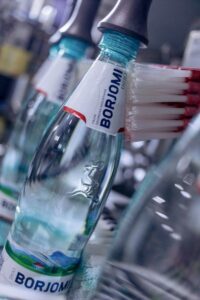
Photo: Borjomi
In 2020 construction started on a further up-to-the-minute, over €40-million facility in the historial spa town of Borjomi. Kitted out with hightech from Germany in the main, this is setting new standards for the industry and the region and pumping new impetus into the country’s economy. When finished, the new bottling plant covering 25,000 square meters will provide 20% more jobs and enable capacity to be doubled in the medium term. This is to allow the growing demand to be met on the one hand and the portfolio to be expanded as and when required on the other. Ecology is especially important here: for instance, the new machines have been optimized for efficient use of energy and water and a cutting-edge sewage plant filters wastewater. Much of the work has already been finished; the logistics centers and railroad connections are expected to be completed by the end of 2024.
Aside from supplying large proportions of the equipment for the process technology and filling and packaging systems, KHS has taken on the role of consultant and general contractor, on whose experience the beverage bottler is happy to rely. “We have complete trust in KHS’ technological expertise when it comes to the filling of mineral water and carbonated soft drinks,” says Gia Shatirishvili, industrial development director for IDS Borjomi Georgia. “Together we’ve drawn up a conceptual master plan that consists of the technical preparation, calculation of production and supply capacities and the perspective layout of the new factory.” Specifically, KHS is helping to dimension the water treatment area, manage supply to the lines with media such as steam, air, CO2 and cooling and plan the supply networks and CIP concepts. The engineers from Dortmund are also involved in the design of the production shop.
Hightech for PET and cans
Two turnkey KHS lines have already been installed and commissioned: an InnoPET BloFill stretch blow molder/filler block is being used to fill PET bottles holding between 0.5 and 1.25 liters at a rate of up to 30,000 containers per hour. KHS’ Bottles & Shapes experts provided direct assistance in dialog with the customer’s marketing personnel when it came to redesigning the plastic bottles. They supported the optimization of the iconic Borjomi bottle in many different ways, namely by enabling the legendary stag to be embossed on the containers. The block itself features an Innofill DRV filler that’s also state of the art. Further highlights in the line’s wet section include a Paramix C blender and an Innoket Neo Flex 90 labeler – one of the first with a swivel arm HMI. With the help of four cameras the three cold glue paper labels on the body, shoulder and back of each bottle are aligned with the brand logo exactly as specified by the marketing department. The dry section ends with an Innopack Kisters SP Advanced shrink packer with a handle applicator and the flexible palletizing technology of the Innopal PB N combined with an Innopal RG grouping system.
Up to 36,000 beverage cans per hour are filled on the second line. After blending on the Paramix C, the cans are fed to the compact Innofill Can C filler before traveling on to a seamer from Swiss engineering company Ferrum, a KHS Innopro KZE flash pasteurizer and a tunnel pasteurizer. As the beverages are exported to 40 countries, calling for a large number of language variants, the 330-milliliter sleek cans printed with the brand motif on the front are dressed with the appropriate pressure-sensitive label on the back. In the dry section an Innopack Kisters TSP for trays and shrink film is used for packing. An Innopal LD Z depalletizer transports the empty cans to the packaging line, with an Innopal PB N again used to palletize the packaged products.
Customized process technology
Regarding the process technology, KHS has also contributed a fully customized syrup room that can serve not just the two new lines already installed but also two more in the future and boasts several special features.
“The complex water concept is controlled from here by the process control system,” explains Ilya Kukushkin, technical sales manager for key accounts at KHS. “It enables recipes to be managed, for example, and is especially operator friendly, particularly in combination with the fully automatic valve manifold. Besides machines for the manufacture, treatment and storage of sugar syrup, the syrup room includes funnels and suction lances for the dispatch and processing of liquid and solid small components and a barrel emptying station for viscous concentrates – all directly connected to the six mixing tanks that hold 10.5 or 22 cubic meters respectively. All kinds of basic substances can be produced in these; the customer has full flexibility here.”
Three CIP stations have also been integrated: one for the two lines, one for the syrup room and one for the water treatment unit including all water pipelines. “The piping includes the four-kilometer-long link to the dosing station for disinfectants at the old plant. This is the longest cleaned pipe I’ve ever heard of,” quipped Kukushkin.
In addition, in 2023, the order for a further PET line went to KHS, the is now able to fill up to 36,000 1.5-liter bottles per hour – a brand new container size for the bottler. “What we particularly appreciate about KHS are its end-to-end systems that effect an excellent balance between high line efficiency and a small machine footprint,” Shatirishvili concluded.

