
Featured Posts
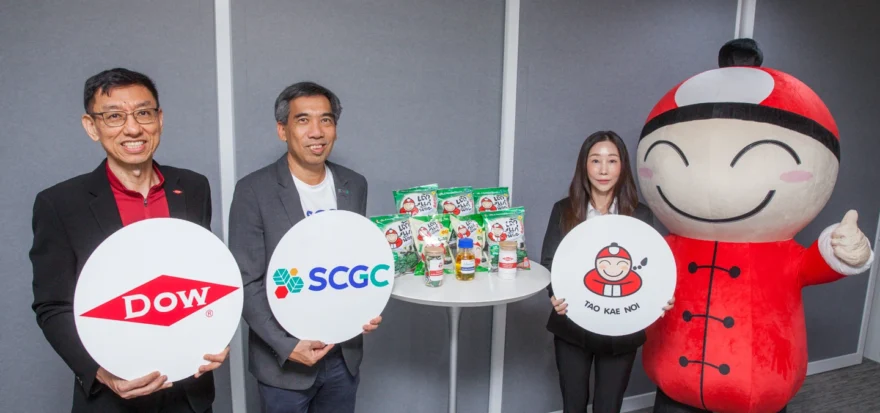
Bangkok – 25 February 2026: Marking the first-ever collaboration of three industry leaders, Taokaenoi Food & Marketing Public Company Limited, or TKN, a manufacturer of seaweed snacks distributed domestically and internationally, SCG Chemicals, or SCGC, a leading integrated polymer and solutions provider for sustainability, and Dow Thailand Group, or Dow, a global leader in materials science, have jointly announced the signing of a landmark Memorandum of Understanding (MoU) to revolutionize the snack industry through the “Food-Grade Circular Packaging by Advanced Recycling Technology” project. This initiative aims to sustainably address plastic waste challenges under the concept of closed-loop recycling. This collaboration entails utilizing multi-layer packaging waste from the production processes of Taokaenoi, which was previously difficult to recycle. This waste will be processed using the advanced recycling technology of SCGC and converted back into circular feedstock. Following this, Dow will utilize the feedstock to produce new, clean, and food-grade plastic resins. These resins will then be safely used to manufacture food packaging for the Taokaenoi brand once again. It is anticipated that the packaging will be ready for commercial distribution by the end of 2026. Ms. Orrapat Peeradechapan, Chief Executive Officer of Taokaenoi Food & Marketing Public Company Limited, said, “Taokaenoi is committed to creating happiness for consumers through high-quality snacks, alongside prioritizing ESG (Environmental, Social, and Governance) principles by emphasizing sustainable economic, social, and environmental development. This collaboration represents a significant milestone that transforms the ‘challenge’ of hard-to-recycle packaging into an ‘opportunity’ to establish a practical circular economy. It is not merely about waste disposal, but rather about creating new value from used plastic. We do not only deliver great-tasting products, but we also aim to deliver a better world to consumers through eco-friendly packaging innovations that are clean, safe, and tangibly reduce environmental impacts. This will drive our business to grow alongside genuine sustainability.” Dr. Suracha Udomsak, Chief Operations and Innovation Officer of SCGC, said, “This collaboration reflects the capability of SCGC in utilizing advanced recycling technology to manage plastic packaging composed of multiple materials, which is difficult to recycle, and converting it back into circular feedstock. This feedstock can be used to produce new plastic resins (Certified Circular Polyolefin Resin), which possess properties and quality entirely equivalent to standard virgin plastic resins in all respects and are safe for direct food contact. As a result, the materials can be reused to manufacture food packaging for Taokaenoi. In addition, our process has achieved the globally recognized sustainability certification, ISCC PLUS (International Sustainability and Carbon Certification), throughout the entire supply chain, making SCGC the first company in ASEAN to achieve such certification. This partnership is considered a crucial step in driving SCGC’s goal of reintegrating used plastic into the circular economy system at a volume of 500,000 tons per year by 2030, through collaborations with business partners across the entire value chain.” Meanwhile, Mr. Vichan Tangkengsirisin, President of Dow Thailand, added, “As a materials science leader, Dow is proud to support this collaboration in Thailand by applying our technology to produce circular plastic resins from used flexible packaging feedstock with performance equivalent to fossil-based plastics. Dow Thailand Group’s polyethylene facility in Rayong is ISCC PLUS certified for its capability of converting advanced recycled feedstock into high quality, food grade circular resins. This initiative represents an important step toward closing the plastics loop in Thailand and advancing Dow’s sustainability ambition to transform the waste through collaboration with customers and value chain partners.” This collaboration serves as a model for the comprehensive management of used multi-layer plastic packaging. It reduces the accumulation of plastic waste in the country and decreases the consumption of new resources. This aligns with the sustainability goals of Taokaenoi, SCGC, and Dow, reinforcing the role of the business sector in tangibly driving the circular economy to build a sustainable future together.
Year 2024
July 2024

Innovia to launch extended portfolio of recycled content films

5 July 2024 – Innovia Films, a leading material science pioneer and major producer of BOPP films, has announced the launch of an extension to their range of sustainable films, that have been marketed under the Encore brand name. The new additions include mechanically and advanced recycled content for BOPP films as well as a Prevented Ocean Plastics option to drive circularity.

“One big cornerstone of the Packaging and Packaging Waste Regulation (PPWR) is the integration of a certain percentage of recycled post-consumer content into plastic packaging. This regulation will have a huge impact on how brands are going to design their packaging and the motivation for this regulation is to reduce the per capita quantity of packaging”, says Simon Huber, Managing Director Innovia Europe.

“Flexible packaging, being lightweight and highly resource efficient, can help reduce the total amount of packaging being used and has a much lower CO2 footprint regarding transportation than many rigid alternatives. Innovia is working with the whole value chain in initiatives like CEFLEX (Circular Economy for Flexible Packaging) to increase the recycling of this flexible packaging back into film. The inclusion of recycled content in new films is top of the list for much of the industry – moving from a linear to a more circular system” explains Steve Langstaff, Head of Recycling at Innovia Films.

More recycled content options for converters and brand owners

The extension to the Encore range of sustainable BOPP films include the use of chemical recycled polymer for food contact applications and the addition of mechanically recycled PCR for non-food. Innovia are also working closely with Prevented Ocean Plastic and have developed a film with 30% POP material. In all cases the key functionality of the BOPP remain intact and are comparable to virgin grade materials.

The environmental credentials of the films can be improved further, by reducing the quantity of fossil based virgin materials and replacing with bio based polypropylene. This reduces the carbon footprint of the films further and again with no detrimental effect on film properties.

“All products are now available for trialling”, Innovia announced.