
Featured Posts
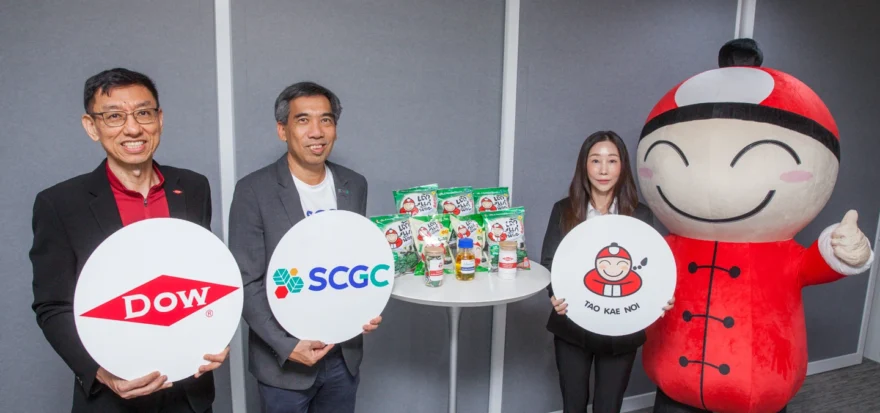
Bangkok – 25 February 2026: Marking the first-ever collaboration of three industry leaders, Taokaenoi Food & Marketing Public Company Limited, or TKN, a manufacturer of seaweed snacks distributed domestically and internationally, SCG Chemicals, or SCGC, a leading integrated polymer and solutions provider for sustainability, and Dow Thailand Group, or Dow, a global leader in materials science, have jointly announced the signing of a landmark Memorandum of Understanding (MoU) to revolutionize the snack industry through the “Food-Grade Circular Packaging by Advanced Recycling Technology” project. This initiative aims to sustainably address plastic waste challenges under the concept of closed-loop recycling. This collaboration entails utilizing multi-layer packaging waste from the production processes of Taokaenoi, which was previously difficult to recycle. This waste will be processed using the advanced recycling technology of SCGC and converted back into circular feedstock. Following this, Dow will utilize the feedstock to produce new, clean, and food-grade plastic resins. These resins will then be safely used to manufacture food packaging for the Taokaenoi brand once again. It is anticipated that the packaging will be ready for commercial distribution by the end of 2026. Ms. Orrapat Peeradechapan, Chief Executive Officer of Taokaenoi Food & Marketing Public Company Limited, said, “Taokaenoi is committed to creating happiness for consumers through high-quality snacks, alongside prioritizing ESG (Environmental, Social, and Governance) principles by emphasizing sustainable economic, social, and environmental development. This collaboration represents a significant milestone that transforms the ‘challenge’ of hard-to-recycle packaging into an ‘opportunity’ to establish a practical circular economy. It is not merely about waste disposal, but rather about creating new value from used plastic. We do not only deliver great-tasting products, but we also aim to deliver a better world to consumers through eco-friendly packaging innovations that are clean, safe, and tangibly reduce environmental impacts. This will drive our business to grow alongside genuine sustainability.” Dr. Suracha Udomsak, Chief Operations and Innovation Officer of SCGC, said, “This collaboration reflects the capability of SCGC in utilizing advanced recycling technology to manage plastic packaging composed of multiple materials, which is difficult to recycle, and converting it back into circular feedstock. This feedstock can be used to produce new plastic resins (Certified Circular Polyolefin Resin), which possess properties and quality entirely equivalent to standard virgin plastic resins in all respects and are safe for direct food contact. As a result, the materials can be reused to manufacture food packaging for Taokaenoi. In addition, our process has achieved the globally recognized sustainability certification, ISCC PLUS (International Sustainability and Carbon Certification), throughout the entire supply chain, making SCGC the first company in ASEAN to achieve such certification. This partnership is considered a crucial step in driving SCGC’s goal of reintegrating used plastic into the circular economy system at a volume of 500,000 tons per year by 2030, through collaborations with business partners across the entire value chain.” Meanwhile, Mr. Vichan Tangkengsirisin, President of Dow Thailand, added, “As a materials science leader, Dow is proud to support this collaboration in Thailand by applying our technology to produce circular plastic resins from used flexible packaging feedstock with performance equivalent to fossil-based plastics. Dow Thailand Group’s polyethylene facility in Rayong is ISCC PLUS certified for its capability of converting advanced recycled feedstock into high quality, food grade circular resins. This initiative represents an important step toward closing the plastics loop in Thailand and advancing Dow’s sustainability ambition to transform the waste through collaboration with customers and value chain partners.” This collaboration serves as a model for the comprehensive management of used multi-layer plastic packaging. It reduces the accumulation of plastic waste in the country and decreases the consumption of new resources. This aligns with the sustainability goals of Taokaenoi, SCGC, and Dow, reinforcing the role of the business sector in tangibly driving the circular economy to build a sustainable future together.
Year 2024
August 2024

ExxonMobil provides Videplast with an alternative to ionomer vacuum skin packaging

16 August 2024 – ExxonMobil has collaborated with Videplast, a Brazilian packaging converter, to develop a cost-effective vacuum skin packaging (VSP) solution that does not contain ionomer. Videplast will use ExxonMobil’s Exceed XP 7052ML performance PE as a high-performance, cost-effective solution for fruit, vegetable, cheese and meat products.

VSP is placed on a tray (plastic or cardboard) and a thin barrier film is softened by heat and draped over the product on the tray. A vacuum is applied to ensure the film will cover the entire surface of a product, removing as much air inside the package as possible.

The Challenge
“We identified an opportunity in both the national and international markets to develop a differentiated structure for the VSP film,” says Leonardo Nunes da Silva, R&D manager at Videplast.

The solution
By employing ExxonMobil’s Exceed™ XP 7052ML performance PE the advanced packaging solution offer significant cost-savings by reducing film thickness and eliminating the need for ionomers. Enhanced protection from food spoilage, leakage and contamination support extended shelf-life and by removing air, ensuring qualtiy and food safety for perishable products.

“By creating a unique structure in the market that does not contain ionomers, we anticipated an opportunity for us to offer our customers a high-performance, cost-effective solution.”

Leandro Barcarolo Martinoto, R&D manager at Videplast, says: “We consider
our collaboration with ExxonMobil to be of the utmost relevance in terms of innovation and technology, prioritizing high quality and superior performance of the materials provided. When we requested a structure for the development of the skin film, we were promptly presented with an innovative proposal, aiming for market prominence. Through this work, we achieved the development of a down-gauged structure that does not contain ionomers. This is the type of collaboration that helps drive not only our business but can also support shifts in industry standards.”

“The progress achieved in the VSP project generates high expectations. The implementation of VSP has the potential to generate substantial long-term savings. We are convinced of the positive impact that VSP will bring to our operations, expanding into new export markets, discovering innovative applications and optimizing operational costs.”

ExxonMobil’s polyethylene portfolio provides converters and brand owners with an extensive range of performance polymers, specialty co-polymers, and additional polyethylene grades for various applications.