
Featured Posts
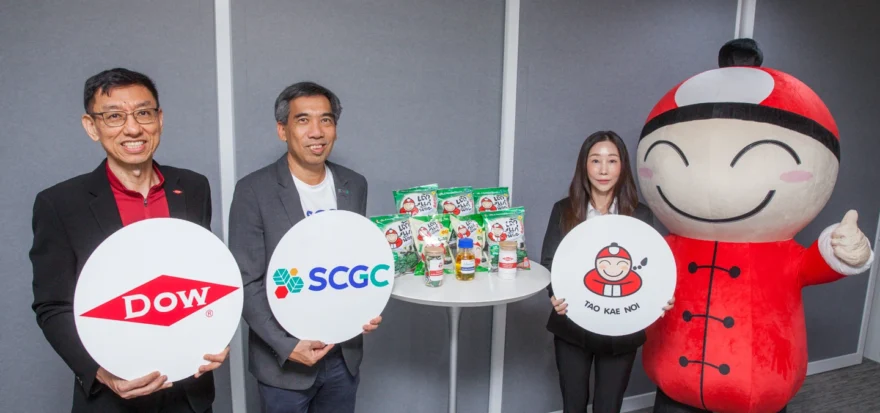
Bangkok – 25 February 2026: Marking the first-ever collaboration of three industry leaders, Taokaenoi Food & Marketing Public Company Limited, or TKN, a manufacturer of seaweed snacks distributed domestically and internationally, SCG Chemicals, or SCGC, a leading integrated polymer and solutions provider for sustainability, and Dow Thailand Group, or Dow, a global leader in materials science, have jointly announced the signing of a landmark Memorandum of Understanding (MoU) to revolutionize the snack industry through the “Food-Grade Circular Packaging by Advanced Recycling Technology” project. This initiative aims to sustainably address plastic waste challenges under the concept of closed-loop recycling. This collaboration entails utilizing multi-layer packaging waste from the production processes of Taokaenoi, which was previously difficult to recycle. This waste will be processed using the advanced recycling technology of SCGC and converted back into circular feedstock. Following this, Dow will utilize the feedstock to produce new, clean, and food-grade plastic resins. These resins will then be safely used to manufacture food packaging for the Taokaenoi brand once again. It is anticipated that the packaging will be ready for commercial distribution by the end of 2026. Ms. Orrapat Peeradechapan, Chief Executive Officer of Taokaenoi Food & Marketing Public Company Limited, said, “Taokaenoi is committed to creating happiness for consumers through high-quality snacks, alongside prioritizing ESG (Environmental, Social, and Governance) principles by emphasizing sustainable economic, social, and environmental development. This collaboration represents a significant milestone that transforms the ‘challenge’ of hard-to-recycle packaging into an ‘opportunity’ to establish a practical circular economy. It is not merely about waste disposal, but rather about creating new value from used plastic. We do not only deliver great-tasting products, but we also aim to deliver a better world to consumers through eco-friendly packaging innovations that are clean, safe, and tangibly reduce environmental impacts. This will drive our business to grow alongside genuine sustainability.” Dr. Suracha Udomsak, Chief Operations and Innovation Officer of SCGC, said, “This collaboration reflects the capability of SCGC in utilizing advanced recycling technology to manage plastic packaging composed of multiple materials, which is difficult to recycle, and converting it back into circular feedstock. This feedstock can be used to produce new plastic resins (Certified Circular Polyolefin Resin), which possess properties and quality entirely equivalent to standard virgin plastic resins in all respects and are safe for direct food contact. As a result, the materials can be reused to manufacture food packaging for Taokaenoi. In addition, our process has achieved the globally recognized sustainability certification, ISCC PLUS (International Sustainability and Carbon Certification), throughout the entire supply chain, making SCGC the first company in ASEAN to achieve such certification. This partnership is considered a crucial step in driving SCGC’s goal of reintegrating used plastic into the circular economy system at a volume of 500,000 tons per year by 2030, through collaborations with business partners across the entire value chain.” Meanwhile, Mr. Vichan Tangkengsirisin, President of Dow Thailand, added, “As a materials science leader, Dow is proud to support this collaboration in Thailand by applying our technology to produce circular plastic resins from used flexible packaging feedstock with performance equivalent to fossil-based plastics. Dow Thailand Group’s polyethylene facility in Rayong is ISCC PLUS certified for its capability of converting advanced recycled feedstock into high quality, food grade circular resins. This initiative represents an important step toward closing the plastics loop in Thailand and advancing Dow’s sustainability ambition to transform the waste through collaboration with customers and value chain partners.” This collaboration serves as a model for the comprehensive management of used multi-layer plastic packaging. It reduces the accumulation of plastic waste in the country and decreases the consumption of new resources. This aligns with the sustainability goals of Taokaenoi, SCGC, and Dow, reinforcing the role of the business sector in tangibly driving the circular economy to build a sustainable future together.
Year 2020
May 2020

Alpla expands PET recycling facility in Poland

30 April 2020 – A new rPET extrusion system will be going into operation in early May 2020 at the recycling plant PET Recycling Team in Radomsko, Poland. 

As a result, the capacity for rPET (PET regrind material) will be doubled from 15,000 to 30,000 tons per annum.  

Georg Lässer, head of Recycling at ALPLA, explained this new development: “A key target is the expansion of recycling activities by 2025,” he said. “Anyone who follows ALPLA on any of the company’s various channels is bound to have read or heard this sentence several times recently,” he said. “At the end of 2018, we signed the New Plastics Economy Global Commitment – an initiative of the Ellen MacArthur Foundation – which, amongst other things, commits us to invest a total of €50 million in pursuit of this aim.

“We take this voluntary commitment seriously and have initiated several international projects, such as the construction of a recycling plant in Thailand. We are also investing in the expansion and improvement of our existing recycling plants. We aim to process even more recycled material for the bottle-to-bottle cycle and make the production processes at our recycling plants more sustainable by means of modernization.”

New extrusion line in Poland
At the beginning of May, a second rPET extrusion line will be going into operation at the PET recycling plant in Radomsko.

The 90 employees at PET Recycling Team Radomsko produce 30,000 tons of flakes a year from post-consumer material. Of this figure, 15,000 tons a year has thus far been extruded to produce regrind material. With the new system, the capacity will increase to 30,000 tons a year. “As a result, we are doubling the capacity for high-quality rPET, which can then be fed back into the bottle cycle. Downcycling (e.g. the use of flakes to produce film or their deployment in the textile industry) will largely be avoided,” Lässer said. “Instead, 30,000 tons of regrind material will now be used solely to produce new packaging units for European customers – in keeping with the bottle-to-bottle principle. What’s more, all the input material – known as ‘post-consumer material’ – also comes from Europe, i.e. from Poland and neighboring countries. 

“The new extrusion system itself is supplied by Austrian firm Starlinger, whose cutting-edge recycling technology ALPLA has been using for many years.”

Green electricity improves carbon footprint.
In addition to the technical expansion of the plant, its energy supply has been switched fully to renewables. As shown by the carbon footprint calculation performed by independent consultancy firm c7-consult, the production of one kilogram of PET regrind material only generates 0.27 kilograms of carbon equivalent. This corresponds to 88% (or eight times) less greenhouse gas than the production of virgin material (2.19 kg of carbon equivalent according to PlasticsEurope).

Forward-looking strategy
As an international developer and manufacturer of plastic packaging, ALPLA recognized the importance of recycling at an early stage and was already entering into partnerships in the early 2000s. 

Alpla acquired Austrian company PET Recycling Team Wöllersdorf in 2010 and constructed an in-house recycling plant in Poland in 2012 to enhance its recycling operations.

However, the demand for recycled plastic has not always been as high as it is today.

Beata Szynkiewicz, commercial director at PRT Radomsko said “Over the years, PRT has held its own in a challenging market environment, helping to ensure that PET packaging units are seen as recyclables. Our market is now ready and, with the new set-up, we are in a strong position to make high-quality regrind material in the most sustainable way possible.”