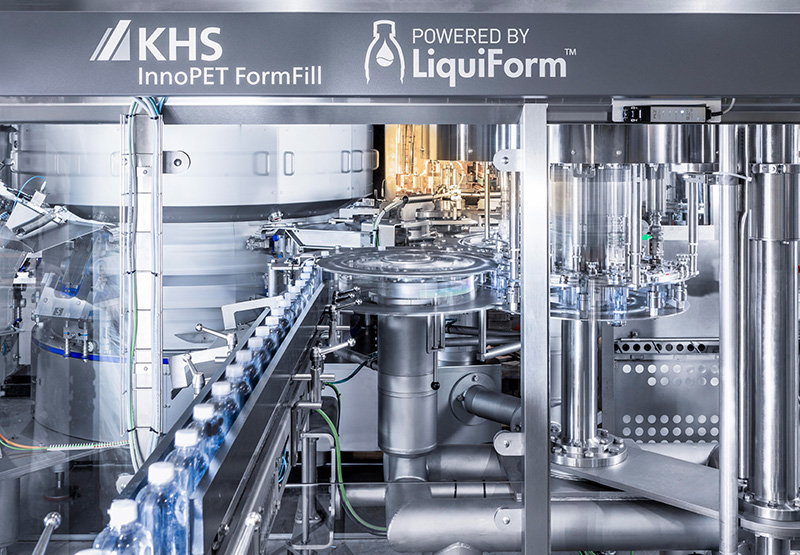

KHS Formfill in final acceptance : technology combines stretch blow molding and filling unit
Featured Posts
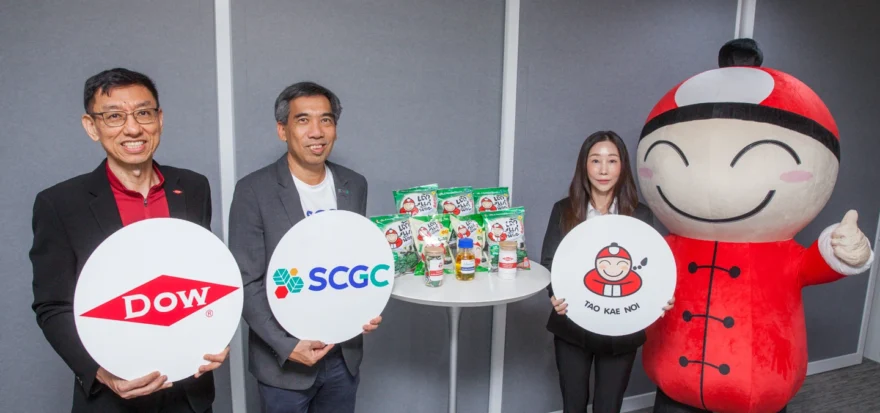
Bangkok – 25 February 2026: Marking the first-ever collaboration of three industry leaders, Taokaenoi Food & Marketing Public Company Limited, or TKN, a manufacturer of seaweed snacks distributed domestically and internationally, SCG Chemicals, or SCGC, a leading integrated polymer and solutions provider for sustainability, and Dow Thailand Group, or Dow, a global leader in materials science, have jointly announced the signing of a landmark Memorandum of Understanding (MoU) to revolutionize the snack industry through the “Food-Grade Circular Packaging by Advanced Recycling Technology” project. This initiative aims to sustainably address plastic waste challenges under the concept of closed-loop recycling. This collaboration entails utilizing multi-layer packaging waste from the production processes of Taokaenoi, which was previously difficult to recycle. This waste will be processed using the advanced recycling technology of SCGC and converted back into circular feedstock. Following this, Dow will utilize the feedstock to produce new, clean, and food-grade plastic resins. These resins will then be safely used to manufacture food packaging for the Taokaenoi brand once again. It is anticipated that the packaging will be ready for commercial distribution by the end of 2026. Ms. Orrapat Peeradechapan, Chief Executive Officer of Taokaenoi Food & Marketing Public Company Limited, said, “Taokaenoi is committed to creating happiness for consumers through high-quality snacks, alongside prioritizing ESG (Environmental, Social, and Governance) principles by emphasizing sustainable economic, social, and environmental development. This collaboration represents a significant milestone that transforms the ‘challenge’ of hard-to-recycle packaging into an ‘opportunity’ to establish a practical circular economy. It is not merely about waste disposal, but rather about creating new value from used plastic. We do not only deliver great-tasting products, but we also aim to deliver a better world to consumers through eco-friendly packaging innovations that are clean, safe, and tangibly reduce environmental impacts. This will drive our business to grow alongside genuine sustainability.” Dr. Suracha Udomsak, Chief Operations and Innovation Officer of SCGC, said, “This collaboration reflects the capability of SCGC in utilizing advanced recycling technology to manage plastic packaging composed of multiple materials, which is difficult to recycle, and converting it back into circular feedstock. This feedstock can be used to produce new plastic resins (Certified Circular Polyolefin Resin), which possess properties and quality entirely equivalent to standard virgin plastic resins in all respects and are safe for direct food contact. As a result, the materials can be reused to manufacture food packaging for Taokaenoi. In addition, our process has achieved the globally recognized sustainability certification, ISCC PLUS (International Sustainability and Carbon Certification), throughout the entire supply chain, making SCGC the first company in ASEAN to achieve such certification. This partnership is considered a crucial step in driving SCGC’s goal of reintegrating used plastic into the circular economy system at a volume of 500,000 tons per year by 2030, through collaborations with business partners across the entire value chain.” Meanwhile, Mr. Vichan Tangkengsirisin, President of Dow Thailand, added, “As a materials science leader, Dow is proud to support this collaboration in Thailand by applying our technology to produce circular plastic resins from used flexible packaging feedstock with performance equivalent to fossil-based plastics. Dow Thailand Group’s polyethylene facility in Rayong is ISCC PLUS certified for its capability of converting advanced recycled feedstock into high quality, food grade circular resins. This initiative represents an important step toward closing the plastics loop in Thailand and advancing Dow’s sustainability ambition to transform the waste through collaboration with customers and value chain partners.” This collaboration serves as a model for the comprehensive management of used multi-layer plastic packaging. It reduces the accumulation of plastic waste in the country and decreases the consumption of new resources. This aligns with the sustainability goals of Taokaenoi, SCGC, and Dow, reinforcing the role of the business sector in tangibly driving the circular economy to build a sustainable future together.
Year 2019
December 2019

KHS Formfill in final acceptance : technology combines stretch blow molding and filling unit

Following the presentation of the future-oriented FormFill concept in 2017 the first system is now undergoing final acceptance in time for this year’s BrauBeviale. The new KHS technology combines the forming and filling of plastic bottles in just one process step. Operators benefit from considerable energy savings and a smaller machine footprint.

Dortmund – KHS first presented its FormFill concept at drinktec in 2017. Back then the ambitious plan was to sufficiently mature the technology in a good two years, enabling the first customer to then profit from its particular benefits. “We’ve learned a lot from the initial concept to the production of the market-ready system,” says Frank Haesendonckx, head of Technology at KHS Corpoplast in Hamburg, Germany. “We’re proud that we’re right on schedule. FormFill is the next stage in development for container forming and filling.”

With its technology KHS combines two processes that were previously separate. On present machinery two individual function modules stretch blow mold the PET preform and then fill the resulting bottle in separate stages. With KHS FormFill bottlers can now form and at the same time fill containers made of PET or rPET on a single machine. The system therefore takes up 40% less space than the standard stretch blow molder/filler blocks common to date. The time saved by the form/fill wheel has even enabled parts of the capping process to be integrated at this point. This then results in the machine being able to prevent product loss during container conveying.

Flexible formats for a range of products

The current tried-and-tested system has been configured for still water. However, the technology is just as suitable for liquid soap and laundry detergent and a whole range of hot fill applications. The current container formats vary from bottles with a volume of 500 milliliters to those holding 1.5 liters. “For the market launch in the coming year we’re focusing on outputs of 12,000 to 24,000 bottles maximum per hour,” states Haesendonckx. KHS subsequently aims to also provide this technology for the medium and high performance ranges. “Here, we’re engaging in active discussion with our clients so that we can also satisfy specific customer requirements.”

Efficient and low on space

“Taking all of the savings into account, FormFill consumes up to 60% less energy compared to a current stretch blow molder/filler block,” Haesendonckx smiles. As in standard plastic container processing to date, the machine first heats the PET preforms. However, instead of compressed air a controlled volume flow of product forms the preforms into containers. This procedure has several advantages: as the inside skin of the containers cools faster than with the standard method through direct filling, FormFill produces containers of greater stiffness with the same wall thickness, thus permitting preform material to be saved. What is known as the ‘water hammer’ effect1 makes design details such as logos more prominent, attracting a great deal of attention at the point of sale even without the presence of bottle labels. In a traditional compressed air process a blow pressure of up to 40 bar would be required to produce the same quality of container.

Another particular advantage is that after capping the trapped gas escapes from the product, creating a slight positive pressure in the container. “This also increases stability which has a positive effect on lightweight bottles especially,” explains Haesendonckx. Maintenance costs are also cut by the use of fewer components and format parts.

1The product filled into the container in fractions of a second presses the preform wall to the mold at an extremely high pressure thanks to the special physical conditions.